Systems Integration

Systems that stop needing a person in the middle.

Most companies do not have a data problem. They have a transfer problem: the same figures rekeyed from the CRM into the ERP into a spreadsheet into an invoice, by someone whose job it should not be, with a typo rate nobody measures.

In one paragraph

AGI Software Solutions builds the integrations that connect the systems you already run — ERP, CRM, accounting, warehouse, e-commerce, payments and internal tools — so records move between them automatically, with reconciliation and failure handling designed in. A single well-scoped integration typically runs $15k–$30k; a multi-system integration programme with data migration runs $40k–$80k, and the usual payback is the manual hours it removes within the first year.

What We Build

The work is in the edge cases.

Any competent developer can move a record from A to B on the happy path. Integration becomes engineering at the second attempt: partial failures, duplicates, out-of-order updates, and the question of which system wins when two disagree.

Accuracy

Rekeying, removed

Data entered once and propagated everywhere it is needed, which eliminates a class of error that no amount of staff diligence ever fully solves.

Reliability

Failure handled as normal

Retries, idempotency and dead-letter queues so a system being briefly unavailable is a logged event rather than a silently lost order.

Visibility

You can see what moved

Every transfer logged and reconcilable, so "did that order reach the warehouse" is a query rather than a phone call.

AI-ready

Data your models can reach

Clean APIs over the systems that hold your operational data — the prerequisite for any AI project that needs more than a document upload.

Plain English

What are software integration services?

Software integration is the work of making separate systems behave as one: moving records between them, keeping them consistent, and resolving what happens when they disagree. In practice it covers API integration, webhooks, scheduled synchronisation, message queues, data migration and the middleware that sits between systems never designed to meet.

The difficult part is not the connection. It is deciding which system holds the truth for each field, what happens when one is unreachable, and how a failed transfer gets retried without creating a duplicate. Integrations that skip those questions work in testing and quietly corrupt data in production.

Compared

Zapier and iPaaS tools vs custom integration

We build on both. This is the split we use to choose — and we will point you at the cheaper option when it fits.

Zapier / Make / iPaaSCustom integration
Best forSimple app-to-app triggersBusiness-critical, high-volume data flows
VolumePriced per task — costly at scaleFixed infrastructure cost regardless of volume
Error handlingRetry and an alert emailReconciliation, dead-letter queues, audit trail
Complex mappingAwkward past a few conditionsWhatever the business rules require
Legacy systemsOnly if a connector existsDatabases, files, SOAP, screen-scraping if needed
Ongoing costPer-task, rising with the businessHosting plus maintenance
How We Build It

Five stages from problem to production.

The same process on every engineering project, scaled to the size of the problem.

01

Discovery

We map what the process actually does today, including the parts that live in one person’s head, and what it costs when it goes wrong.

02

Architecture

Data model, integration points, permissions and hosting decided up front, because these are the choices that are expensive to reverse later.

03

Build in slices

Working software every couple of weeks, sequenced so the riskiest piece reaches real users first rather than last.

04

Integrate and harden

Connecting to the systems that hold your data, then security, load and failure testing against realistic volumes instead of demo data.

05

Handover and support

Documentation, a walkthrough for whoever maintains it, and ongoing support if you want it. The repository is yours either way.

Use Cases

Where systems integration pays off.

The patterns we see deliver, across startups, SMEs and enterprise teams.

Finance

Sales to invoice, automatically

Orders flowing from the storefront or CRM into accounting and back, with tax, discount and credit rules applied consistently.

Operations

Inventory and fulfilment sync

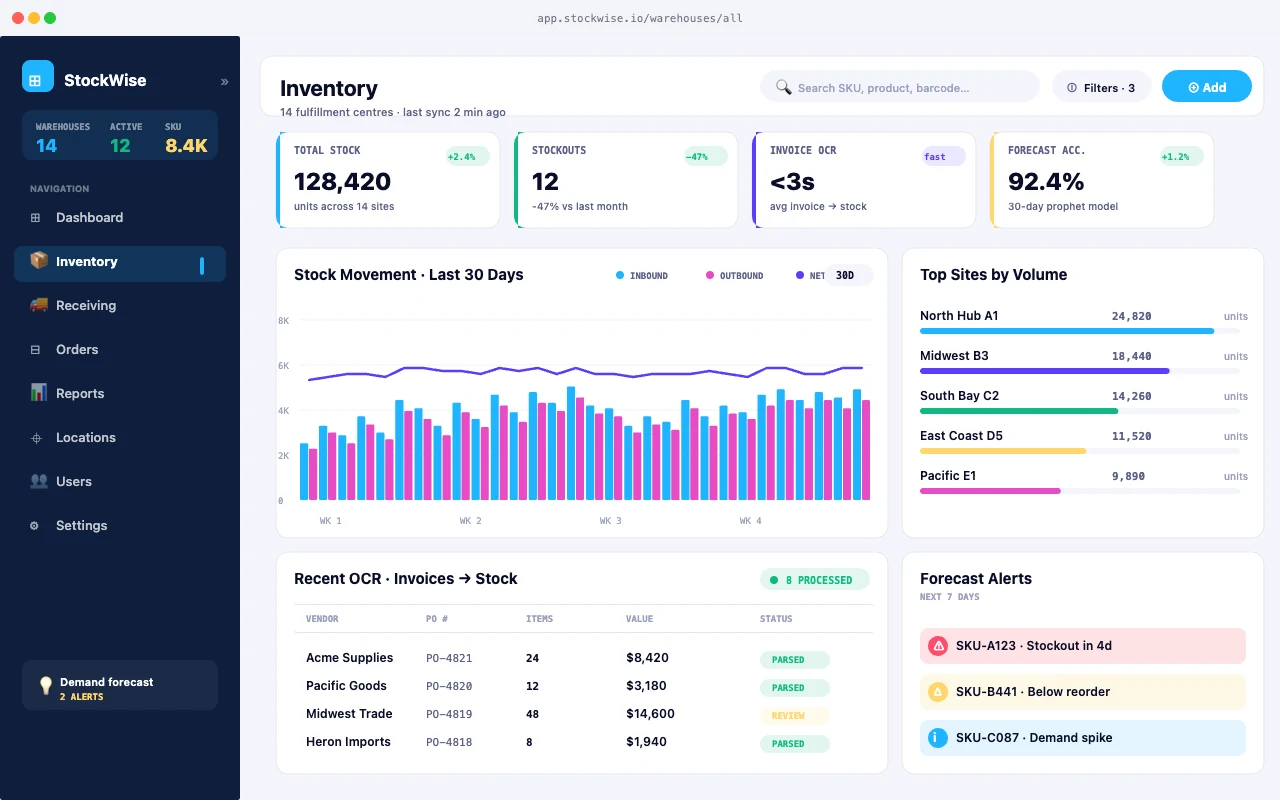
Stock levels, shipments and returns kept consistent across e-commerce, warehouse and ERP without a nightly manual export.

Customer

One view of the customer

Support, sales and billing records joined so the person on the phone can see the whole account rather than one system’s slice of it.

AI

MCP servers and tool access

Exposing your systems to AI assistants and agents through MCP, with scoped permissions, so models can act on real data safely.

Tech Stack

What we build on.

Deliberately boring, widely supported technology. The goal is software your team can still hire for in five years.

Front end

React, Next.js and TypeScript, with server rendering where it earns its keep for speed or SEO.

Back end

FastAPI, Django and Node.js. Python where the work touches data or models, TypeScript where it does not.

Data

PostgreSQL as the default, Redis for caching and queues, and a vector store only when retrieval genuinely needs one.

Infrastructure

Docker and Kubernetes on AWS, GCP, Azure or your own servers. Your cloud account, your bill, your control.

Integration

REST and GraphQL APIs, webhooks, message queues and MCP servers for the systems that need to talk to AI.

Quality

Automated tests, CI on every commit, staged deploys and monitoring wired in before launch rather than after the first outage.

Related Work

Systems we have shipped.
What Teams Say

Hear from the teams we work with.

“We needed a voice agent that could actually qualify leads, not a chatbot pretending to be one. The team shipped a sub-700ms pipeline in 6 weeks. It now handles 5k calls a day.”
Priya RajHead of Growth, Ninjatech
“What sold us was their willingness to put AI engineers and product designers on the same call. We got working prototypes by week two and a production rollout in three months.”
James ThorntonCTO, Allindex
“AGI designed a CRM system tailored to our client management process. It is intuitive, reliable, and has centralized all our communication and history in one dashboard. This has greatly improved client retention.”
Carlos MendesProduct Manager, Qilinlab
Common Questions

Before you get in touch.

How much do software integration services cost?

A single well-scoped integration between two systems typically runs $15k–$30k. A programme connecting several systems with data migration and reconciliation runs $40k–$80k. Where an API is missing or badly documented, discovery is the variable — we scope that separately rather than guessing at it.

What if our system has no API?

There is nearly always a route: a direct database connection, file exports, an undocumented internal endpoint, or a wrapper service in front of the application. We have integrated systems whose vendors insisted it was impossible. It costs more, and we say so up front.

Should we just use Zapier?

If the flow is simple, low-volume and can tolerate an occasional miss, yes — and we will tell you so rather than sell you a build. Custom integration earns its cost when volume makes per-task pricing painful, when the mapping logic is genuinely complex, or when a lost record is a real business problem.

How do you handle two systems disagreeing?

By deciding in advance. For each field we agree which system is authoritative, and conflicts are either resolved by that rule or raised into a review queue. Integrations without that rule do not fail loudly — they quietly diverge until someone notices at year end.

How long does an integration take?

A straightforward two-system integration takes 3–6 weeks including testing against real data. Multi-system programmes run 2–4 months. Most of the schedule is edge cases and reconciliation, not the connection itself.

Can this prepare us for AI?

It is usually the prerequisite. AI projects stall because the data sits in systems the model cannot reach. Clean integrations and MCP servers over your systems are what make assistants and agents possible later, and the integration is worth doing on its own merits regardless.

Talk to us about systems integration.

Tell us what the system would need to do and what it is replacing. We will tell you whether it is worth building and roughly what it takes.