A language model on its own answers from what it was trained on — which is not your contracts, your policies or your product data. RAG connects the model to your content at question time, so answers come from your sources and can be traced back to them.
Annual plans can be refunded in full within 30 days of purchase; after that, refunds are pro-rata to the unused term.
3 sources citedAGI Software Solutions builds custom RAG (retrieval-augmented generation) systems that connect large language models to your documents, databases and knowledge bases, so every answer is grounded in your own content and cited back to its source. We treat retrieval quality as a measured engineering target — chunking, indexing, reranking and evals — because that, not the model, is where RAG projects succeed or fail. Focused builds start around $30k; enterprise deployments with permissions and multiple sources run $60k–$300k.
Every RAG demo works. Production RAG lives or dies on unglamorous details: how documents are chunked, what gets indexed, how results are ranked, and whether anyone measured retrieval before shipping. We build and measure those layers explicitly.
Every answer traceable to the passage it came from, so a person can verify in one click instead of taking the model's word.
New document, new answer. The knowledge base updates by indexing, not by a training run.
Users only get answers synthesised from documents they could open themselves — enforced in the pipeline, not the prompt.
Eval sets for retrieval and answer quality, run on every change, because "it seems to find things" is not a metric.
Retrieval-augmented generation is an architecture in which, before the language model answers, the system retrieves the most relevant passages from your own content — documents, tickets, database records — and hands them to the model as context. The model answers from what was retrieved, not from memory, which is why RAG answers can cite sources and stay current without retraining.
RAG is the right tool when the problem is knowledge: your content changes, it matters who is allowed to see what, and wrong answers must be traceable. It complements rather than replaces fine-tuning, which shapes how a model behaves rather than what it knows.
The most common architecture question we get — and the honest answer is "usually RAG first".
| RAG | Fine-tuning | |
|---|---|---|
| Solves for | What the model knows | How the model behaves |
| Content updates | Immediate — reindex the document | Requires retraining |
| Citations | Built in — answers cite sources | Not possible |
| Permissions | Enforced at retrieval time | Not possible — knowledge is baked in |
| Typical cost | $30k – $300k depending on scale | $15k – $100k+ plus data preparation |
| Choose when | Answers must come from your content | Output format, tone or task needs shaping |
The same process across every AI Development project, scaled to the size of the problem.
We work out what the system actually has to do, what data exists, and what happens today when it goes wrong.
Architecture, model choice, integration points and failure handling, defined before any of it gets built.
Connecting to the systems that hold your data, with security and permission boundaries handled properly.
The system takes on real work, in the workflows your team already uses rather than beside them.
Tuned against real usage and measured with evals, because how people use a system is never quite how it was designed.
The patterns we see deliver, across startups, SMEs and enterprise teams.
Policies, processes and institutional knowledge, answered with citations, for the questions people currently ask each other.
Customer-facing answers drawn only from approved content, with the refusal behaviour that keeps support honest.
Clause-level retrieval across thousands of documents in regulated environments where provenance is non-negotiable.
Search and Q&A features in your own software, built on your customers' data with per-tenant isolation.
Context-aware multi-channel chat that qualifies inbound leads and routes them to the right person.
One inbox across web chat, email, WhatsApp and Facebook, with AI replies trained on past resolutions.
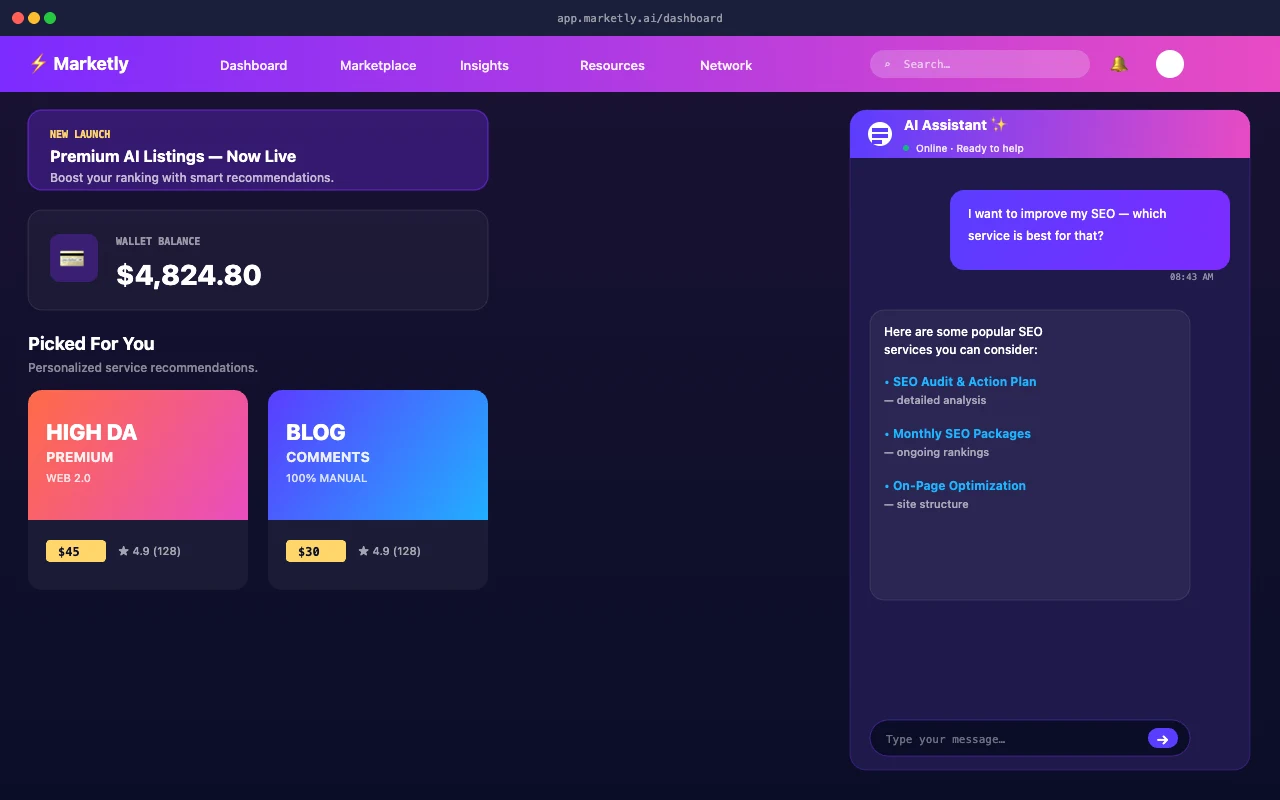
Support chatbot, live SEO analyser and a vector recommendation engine, all sharing one retrieval layer.
“We needed a voice agent that could actually qualify leads, not a chatbot pretending to be one. The team shipped a sub-700ms pipeline in 6 weeks. It now handles 5k calls a day.”
“What sold us was their willingness to put AI engineers and product designers on the same call. We got working prototypes by week two and a production rollout in three months.”
“AGI designed a CRM system tailored to our client management process. It is intuitive, reliable, and has centralized all our communication and history in one dashboard. This has greatly improved client retention.”
Before answering, the system looks up the most relevant passages from your own documents and gives them to the language model to answer from. The model answers from your content, not its memory — which is why the answers can cite sources and stay current.
If the problem is what the model knows (your documents, your data, changing content), RAG. If the problem is how it behaves (format, tone, a specialised task), fine-tuning. Many production systems use RAG first and add fine-tuning only if behaviour still needs shaping.
A focused pilot over one clean content source: roughly $30k–$60k. Enterprise deployments with multiple sources, permission enforcement and eval infrastructure: $60k–$300k. Data quality is the biggest cost variable — messy sources cost more than any model choice.
Yes, and it must. We enforce access control at retrieval time, so the system never synthesises an answer from a document the asking user could not open. This is a hard requirement in most of our deployments, not an add-on.
Grounding narrows the space, but the honest answer is: retrieval evals, answer-quality evals, citation checking, and tuning the system to refuse when the sources do not support an answer. Measured, not assumed.
Tell us what the system would need to do and what it is replacing. We will tell you whether it is worth building and roughly what it takes.