AI Agents

AI agents that finish the job.

Most "agents" are a prompt with a loop around it. The ones that survive contact with production have memory, real tool access, evaluation, and a clear answer to what happens when they get it wrong. We build the second kind.

In one paragraph

AGI Software Solutions is an AI agent development company that builds custom AI agents able to plan multi-step work, call your business systems and complete tasks end to end — with persistent memory, evaluation suites and human approval checkpoints on consequential actions. Typical agent builds range from $20k for a focused single-workflow agent to $120k+ for multi-agent systems wired into several business systems.

What We Build

Agents that do work, not just answer questions.

An agent earns its place when it can complete a task end to end, reading the right data, calling the right systems, and knowing when to stop and ask a person. That is an engineering problem more than a prompting one.

Autonomy

Multi-step work, completed

Agents that plan a sequence, execute it against your systems, and recover when a step fails, rather than stopping at the first surprise.

Control

Approval where it matters

Human checkpoints on the actions that carry real consequences. Full autonomy on the ones that do not.

Memory

Context that persists

Episodic and semantic memory so an agent knows what happened last time instead of starting cold on every run.

Evaluation

Measured, not hoped for

Evals wired in from the start, so you know when a model change makes things worse before your users do.

Plain English

What is an AI agent?

An AI agent is software that uses a large language model to plan and carry out multi-step work: it reads a goal, decides on a sequence of actions, calls tools and systems to execute them, checks the results, and recovers or asks for help when something fails. Where a chatbot produces an answer, an agent produces an outcome — an updated record, a sent confirmation, a completed process.

Production agents add three things demos skip: memory (so run 400 benefits from run 399), evaluation (so you know a change made the agent better, not just different), and permission boundaries (so the agent can only do what the task genuinely requires).

Compared

AI agent vs chatbot: which do you need?

The distinction that decides most projects — and most budgets.

AI chatbotAI agent
Core jobAnswers questions from your dataCompletes multi-step work in your systems
Side effectsNone — it only readsReal — it creates, updates and sends
Oversight neededGrounding and source citationsApproval checkpoints, audit logs, evals
Typical cost$5k – $50k$20k – $120k+
Start here whenThe pain is finding answersThe pain is doing the work
How We Build It

Five stages from problem to production.

The same process across every AI Development project, scaled to the size of the problem.

01

Discovery

We work out what the system actually has to do, what data exists, and what happens today when it goes wrong.

02

Design

Architecture, model choice, integration points and failure handling, defined before any of it gets built.

03

Integration

Connecting to the systems that hold your data, with security and permission boundaries handled properly.

04

Automation

The system takes on real work, in the workflows your team already uses rather than beside them.

05

Refine

Tuned against real usage and measured with evals, because how people use a system is never quite how it was designed.

Use Cases

Where AI agents pay off.

The patterns we see deliver, across startups, SMEs and enterprise teams.

Operations

Order and back-office processing

Agents that read incoming orders, validate them against stock and pricing, update the ERP and send confirmations — with a person approving the exceptions.

Support

Ticket triage and resolution

Agents that classify, enrich and resolve routine tickets end to end, escalating the ones that genuinely need a human.

Sales

CRM hygiene and follow-up

Agents that keep records current, draft follow-ups from call notes and flag deals going quiet — inside the CRM you already run.

Research

Multi-source analysis

Agents that gather from several systems, reconcile the differences and produce a working document a person finishes.

Related Work

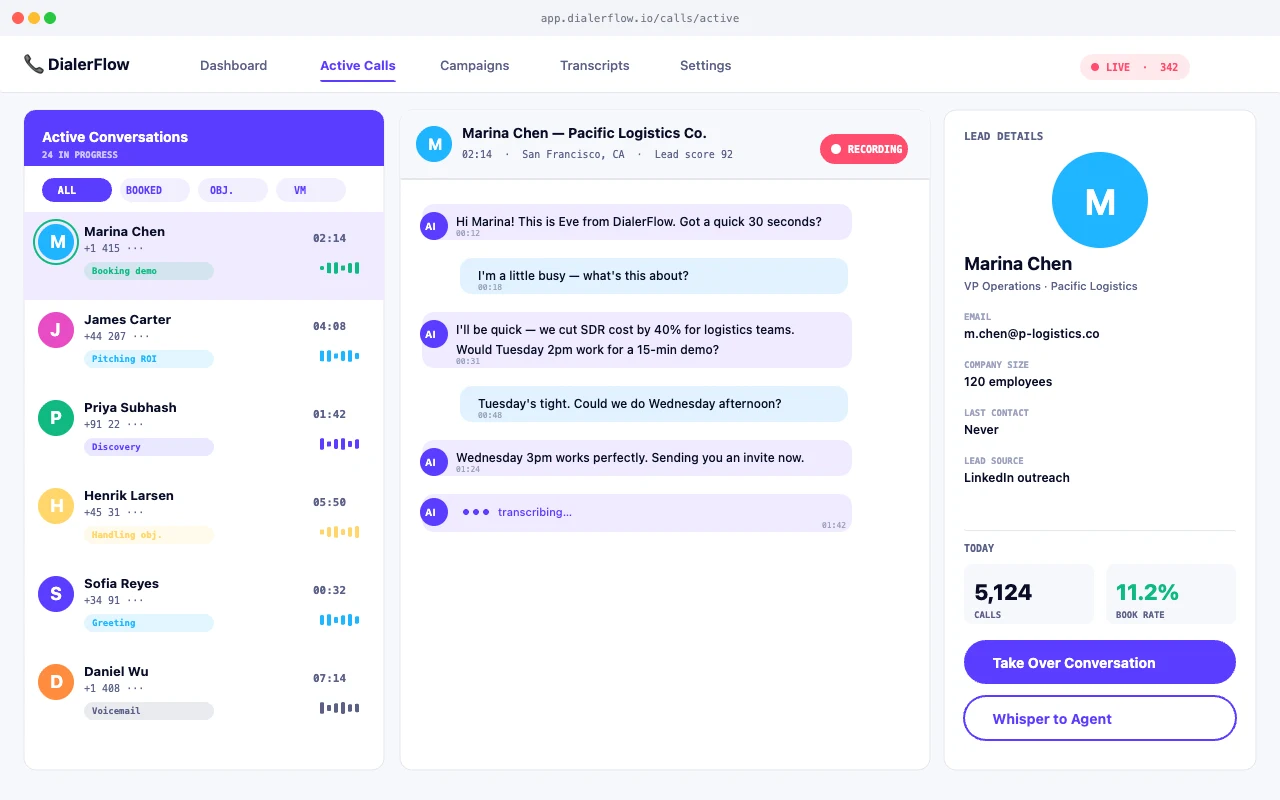
Systems we have shipped.
What Teams Say

Hear from the teams we work with.

“We needed a voice agent that could actually qualify leads, not a chatbot pretending to be one. The team shipped a sub-700ms pipeline in 6 weeks. It now handles 5k calls a day.”
Priya RajHead of Growth, Ninjatech
“What sold us was their willingness to put AI engineers and product designers on the same call. We got working prototypes by week two and a production rollout in three months.”
James ThorntonCTO, Allindex
“AGI designed a CRM system tailored to our client management process. It is intuitive, reliable, and has centralized all our communication and history in one dashboard. This has greatly improved client retention.”
Carlos MendesProduct Manager, Qilinlab
Common Questions

Before you get in touch.

How is an AI agent different from a chatbot?

A chatbot answers. An agent acts: it calls your systems, changes state and completes work. That difference is why agents need approval checkpoints and evaluation that chatbots can get away without.

How much does AI agent development cost?

Typical range: $20k–$40k for a focused agent automating one workflow, $40k–$120k for agents integrated with several business systems, and beyond that for multi-agent platforms. The biggest cost drivers are the number of system integrations and the compliance requirements, not the model.

How long does it take to build an AI agent?

A scoped single-workflow agent usually reaches production in 6–10 weeks. Multi-system agents run 3–6 months. The long pole is rarely the agent logic — it is integration access, evaluation data and approval workflow design.

What stops it doing something destructive?

Scoped tool access, human approval on consequential actions, and audit logging on everything. An agent only gets the permissions the task genuinely needs.

How do you know it is working?

Evals against a fixed set of real cases, run on every change. Without them, "the agent seems better" is the only signal available, and it is not a reliable one.

Talk to us about ai agents.

Tell us what the system would need to do and what it is replacing. We will tell you whether it is worth building and roughly what it takes.