Machine Learning

Models that still work six months after launch.

A model that scores well on last year’s data is a notebook result. A model still earning its keep after the market moved, the product changed and the data drifted is an engineering artefact — and the difference lies almost entirely in what surrounds it.

In one paragraph

AGI Software Solutions builds production machine learning: demand and revenue forecasting, churn and risk scoring, classification, ranking, recommendation and anomaly detection, trained on your own data and deployed with monitoring for drift and automated retraining. Typical ML builds run $20k–$45k for a single model in production and $50k–$100k+ for multi-model systems with a feature store and retraining pipeline. Where a simpler statistical method would do the job, we will tell you.

What We Build

Not everything needs a language model.

A great deal of what gets labelled AI is ordinary supervised learning over tabular data — orders of magnitude cheaper to run, faster to respond, easier to explain, and far easier to defend to a regulator than an LLM doing the same job badly.

Baselines

Measured against the simple option

Every model is benchmarked against the naive forecast or the rule you use today. If it does not beat that by a margin worth the complexity, it should not ship — and we will say so.

Drift

Monitored after launch

Input distributions and prediction quality tracked in production, because a model does not fail with an error page. It quietly gets worse while everyone still trusts it.

Retraining

A pipeline, not a person

Retraining automated and versioned, so refreshing the model is a scheduled job rather than a task that depends on whoever originally built it still being around.

Honesty

Confidence made visible

Predictions surfaced with intervals or confidence scores, so the people acting on them know when the number deserves weight and when it does not.

Plain English

When is machine learning the right tool?

Machine learning earns its place when you need a number or a category predicted from history: how much will sell next month, which customer is about to leave, which transaction looks wrong, what to show this user next. These are pattern problems with a measurable right answer, which is exactly what supervised learning is built for.

It is the wrong tool when the rule is already known and could simply be written down, when there is not enough labelled history to learn from, or when nobody has thought through what a wrong prediction costs. We check those three things before proposing a model, because a model built on any of them is expensive theatre.

Compared

Machine learning vs an LLM for the same problem

Both get proposed for prediction work. Only one of them is priced and shaped for it.

Classical MLLarge language model
Input it suitsStructured, tabular, numericText, images, unstructured records
Cost per predictionFractions of a centCents, rising with context length
LatencyMillisecondsHundreds of milliseconds to seconds
ExplainabilityFeature attribution a regulator acceptsHard to attribute precisely
Use it forForecasting, scoring, ranking, anomaliesLanguage, reasoning, extraction from prose
How We Build It

Five stages from problem to production.

The same process across every AI Development project, scaled to the size of the problem.

01

Discovery

We work out what the system actually has to do, what data exists, and what happens today when it goes wrong.

02

Design

Architecture, model choice, integration points and failure handling, defined before any of it gets built.

03

Integration

Connecting to the systems that hold your data, with security and permission boundaries handled properly.

04

Automation

The system takes on real work, in the workflows your team already uses rather than beside them.

05

Refine

Tuned against real usage and measured with evals, because how people use a system is never quite how it was designed.

Use Cases

Where machine learning pays off.

The patterns we see deliver, across startups, SMEs and enterprise teams.

Forecasting

Demand, revenue and staffing

Forecasts built from your own history with seasonality, promotions and known events handled explicitly rather than smoothed away.

Retention

Churn and risk scoring

Which accounts are drifting and which transactions look wrong, scored early enough that somebody can still act on it.

Ranking

Recommendation and prioritisation

What to show, offer or work on next, tuned against the outcome you actually care about rather than click-through as a proxy for it.

Operations

Anomaly and quality detection

Equipment failures, quality escapes and fraud caught from operational data before they turn into a cost.

Related Work

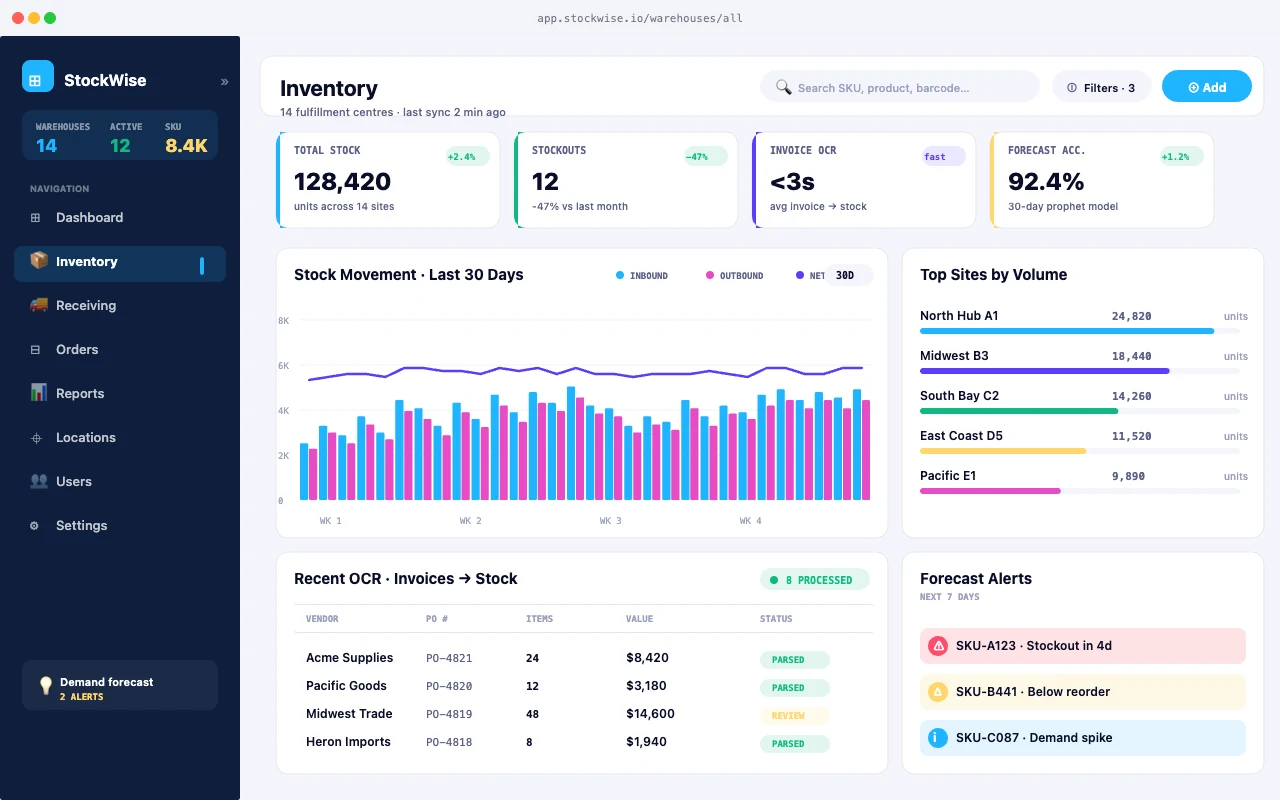
Systems we have shipped.
What Teams Say

Hear from the teams we work with.

“We needed a voice agent that could actually qualify leads, not a chatbot pretending to be one. The team shipped a sub-700ms pipeline in 6 weeks. It now handles 5k calls a day.”
Priya RajHead of Growth, Ninjatech
“What sold us was their willingness to put AI engineers and product designers on the same call. We got working prototypes by week two and a production rollout in three months.”
James ThorntonCTO, Allindex
“AGI designed a CRM system tailored to our client management process. It is intuitive, reliable, and has centralized all our communication and history in one dashboard. This has greatly improved client retention.”
Carlos MendesProduct Manager, Qilinlab
Common Questions

Before you get in touch.

How much data do we need?

It depends on the problem, but for most tabular problems the honest floor is a few thousand labelled examples spanning the range of conditions you care about. For forecasting, breadth beats volume: two years of weekly history is more useful than a million rows from last month, because the model needs to have seen a full seasonal cycle.

How much does machine learning development cost?

A single model taken properly to production runs $20k–$45k. Multi-model systems with a feature store, monitoring and automated retraining run $50k–$100k and up. The biggest variable is data preparation, which regularly consumes more of the budget than the modelling does — and any quote that ignores it is not a real quote.

How long before we know whether this will work?

A feasibility check against your data takes 1–2 weeks and will tell you whether the signal exists at all — which is the question worth answering before committing to anything. A first model in production usually takes 8–14 weeks from there.

What happens when the model stops working?

It will degrade; every deployed model does, because the world it learned stops matching the world it runs in. That is why drift monitoring and a retraining pipeline are part of the build rather than a later phase. The failure you must design against is silent degradation, not a crash.

Can you explain the predictions?

Yes, and for anything touching credit, employment, insurance or health it is a requirement rather than a nicety. We favour model families with usable feature attribution, and where a more opaque model genuinely performs better we make the trade-off explicit rather than deciding it quietly.

Should we use an LLM for this instead?

Not for predicting a number or a category from structured history. An LLM will produce an answer, but it will cost more per call, respond more slowly, and give you far less to show anyone who asks why. Use language models for language; use ML for prediction.

Talk to us about machine learning.

Tell us what the system would need to do and what it is replacing. We will tell you whether it is worth building and roughly what it takes.