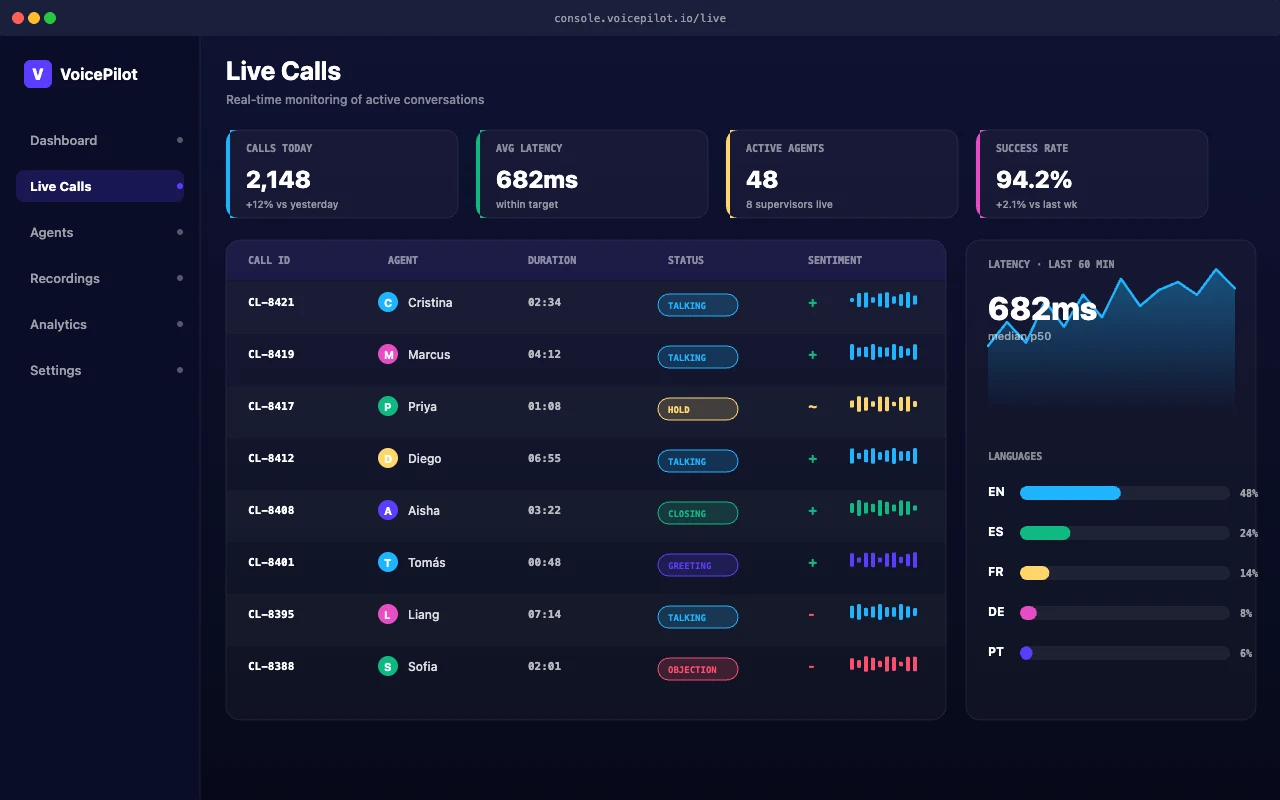
Voice fails on latency before it fails on intelligence. Past about a second of silence, people talk over the agent or hang up. Our production pipelines run at around 680ms end to end, with interruption handled as part of normal conversation.
AGI Software Solutions builds custom voice AI agents for inbound and outbound phone work — booking, support, qualification and follow-up — on streaming pipelines that run at 680ms median end-to-end latency in production, across 12 languages, with real barge-in and live human takeover. Custom voice agent builds typically run $20k–$120k depending on integrations and compliance, against $0.40–$0.80 per handled call to operate.
Everything about a voice agent, from the model choice to the streaming architecture to where the work happens, is downstream of one number. We design for it first and treat everything else as a constraint around it.
680ms median end to end in production, with every stage of the pipeline overlapping rather than queued behind the last one.
Callers can interrupt, and the agent stops and listens. Without that, it reads as a phone tree no matter how good the reasoning is.
Production deployments across 12 languages, with per-tenant voice cloning where a brand needs its own voice.
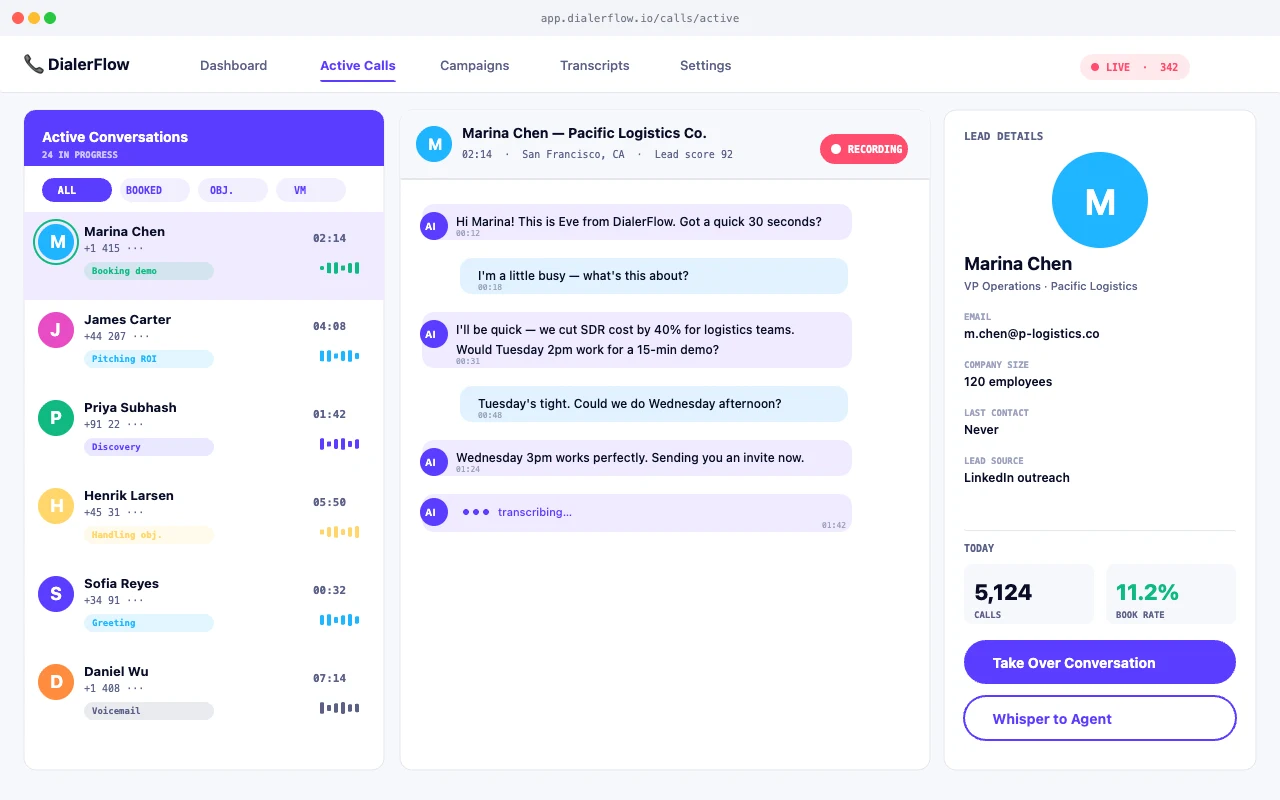
Live supervisor views with whisper and takeover, plus quality, sentiment and outcome analytics on every call.
A voice AI agent is a phone-native conversational system: it listens in real time, interprets intent with a language model, looks things up or acts in your CRM and booking systems mid-call, and responds in natural speech. The difference between one callers use and one they abandon is measured in milliseconds of silence and in whether they can interrupt it like a person.
Both answer your phone. Only one of them holds a conversation.
| IVR menu | Voice AI agent | |
|---|---|---|
| Caller experience | "Press 2 for billing" | Says what they want, in their words |
| Interruption | Not possible | Barge-in handled as normal conversation |
| Systems access | Static routing | Live lookups and actions mid-call |
| Languages | One menu per language, maintained by hand | Same agent, 12+ languages |
| Escalation | Queue transfer | Context-rich handover, supervisor whisper and takeover |
The same process across every AI Development project, scaled to the size of the problem.
We work out what the system actually has to do, what data exists, and what happens today when it goes wrong.
Architecture, model choice, integration points and failure handling, defined before any of it gets built.
Connecting to the systems that hold your data, with security and permission boundaries handled properly.
The system takes on real work, in the workflows your team already uses rather than beside them.
Tuned against real usage and measured with evals, because how people use a system is never quite how it was designed.
The patterns we see deliver, across startups, SMEs and enterprise teams.
Answers every call, books and reschedules against your live calendar, and takes messages that actually reach the right person.
Order status, account questions and routine requests resolved on the call, with clean escalation for everything else.
Appointment confirmations, renewal reminders and callback queues worked automatically, with TCPA and GDPR-aware handling.
Every inbound lead called back inside a minute, qualified against your criteria, and routed to sales with a transcript.
A streaming voice pipeline with real barge-in, running thousands of live calls a day in 12 languages.
An outbound voice agent that books meetings, qualifies leads and hands warm conversations to humans.
Context-aware multi-channel chat that qualifies inbound leads and routes them to the right person.
“We needed a voice agent that could actually qualify leads, not a chatbot pretending to be one. The team shipped a sub-700ms pipeline in 6 weeks. It now handles 5k calls a day.”
“What sold us was their willingness to put AI engineers and product designers on the same call. We got working prototypes by week two and a production rollout in three months.”
“AGI designed a CRM system tailored to our client management process. It is intuitive, reliable, and has centralized all our communication and history in one dashboard. This has greatly improved client retention.”
Our production systems sit around 680ms median end to end. Getting there is an architecture problem: streaming at every stage, and doing as little sequential work as possible between hearing and speaking.
A basic inbound agent (bookings, FAQs, message-taking) runs roughly $20k–$50k to build. Enterprise deployments with outbound campaigns, CRM integration and multi-language support run $50k–$120k. Operating cost is typically $0.40–$0.80 per call, against $7–$12 for a human-handled call.
Yes. Barge-in and turn-taking are built in. It is one of the clearest dividing lines between a voice agent and an automated phone menu.
Usually through Twilio or your existing telephony provider. The agent handles the conversation; your numbers, routing and recording rules stay where they are.
It can be. We have built TCPA and GDPR-aware handling including automatic opt-out detection, but the specifics depend on your market and use case. That is scoping work.
Tell us what the system would need to do and what it is replacing. We will tell you whether it is worth building and roughly what it takes.