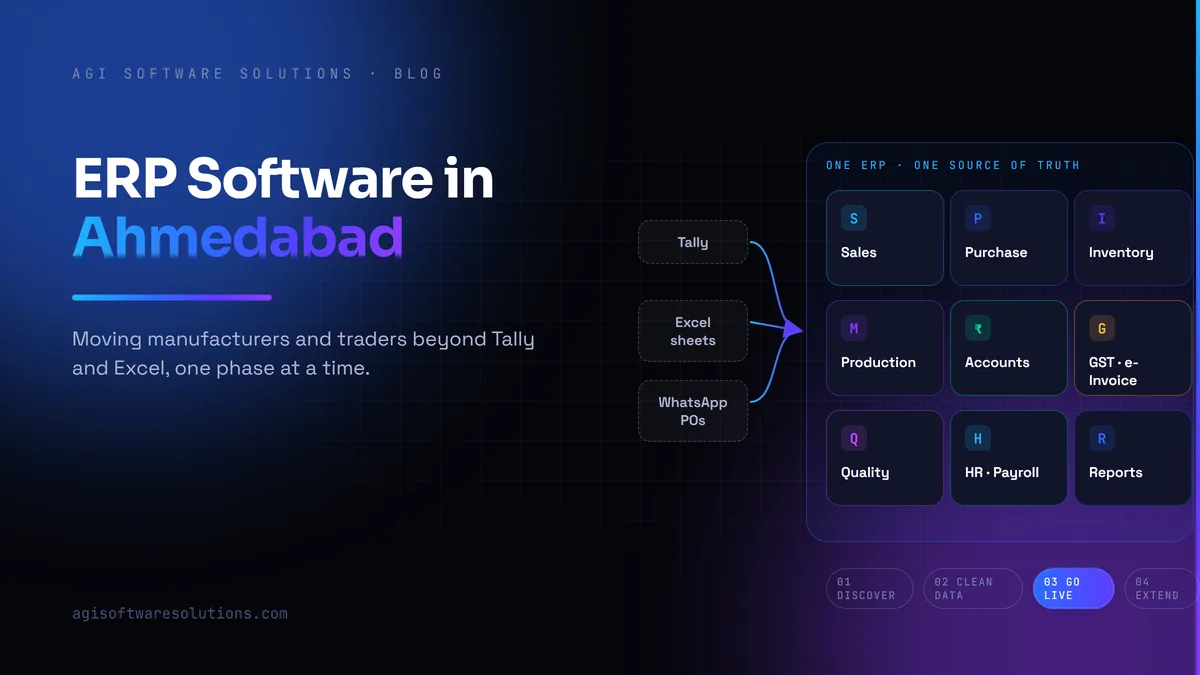
An Ahmedabad business needs ERP software when Tally plus spreadsheets can no longer tell you, in real time, what stock you have, what an order costs to make and what you are owed. The safest path is a phased implementation, starting with inventory and sales, with Tally kept running in parallel until the numbers reconcile.
Tally is excellent accounting software, and for many Ahmedabad businesses it is the right system for years. The trouble starts when the business grows around it: stock is tracked in one Excel file, production in another, purchase approvals on WhatsApp and costing in someone's head. Every month-end becomes a reconciliation exercise. This guide is for manufacturers, traders and distributors in Ahmedabad and across Gujarat who are wondering whether it is time for ERP software, and how to get there without disrupting the business.
Seven signs you have outgrown Tally and Excel
- Nobody trusts the stock figure without a physical count.
- You cannot say the real cost of a product or job until weeks after it ships.
- Sales promises delivery dates without seeing production capacity or raw-material stock.
- Purchase orders are raised from memory or a WhatsApp message, and duplicates happen.
- Month-end closing takes days because data has to be copied between files.
- Multiple branches, warehouses or GSTINs each keep their own version of the truth.
- Key processes depend on one or two people who know where everything is.
If three or more of these sound familiar, the cost of not having an ERP is probably already higher than the cost of implementing one. It just shows up as lost time, excess stock and missed deliveries rather than an invoice.
What is ERP software?
ERP stands for Enterprise Resource Planning. ERP software brings sales, purchasing, inventory, production, quality, accounting, GST compliance and often HR and payroll into one database. The point is not more features; it is one version of each number. When a sales order is booked, stock is reserved, a production plan or purchase request is triggered, and the accounting entry follows, without anyone retyping it. Tally is primarily accounting and inventory software; an ERP extends that single record across operations.
ERP needs by industry in Ahmedabad
Ahmedabad's industrial estates, from Naroda and Vatva to Changodar, Sanand and Odhav, host very different businesses, and an ERP should be chosen around the industry-specific features you cannot work without.
- Pharmaceuticals and chemicals: batch and expiry tracking, quality control and release, formulation-based bills of materials and documentation for audits.
- Engineering and fabrication: multi-level bills of materials, job work sent to subcontractors, drawing revisions, machine and job-card costing.
- Construction and infrastructure: project-wise budgeting, site inventory, subcontractor and running-account billing, and retention tracking.
- Textiles and trading: variants by quality, colour and size, agent commissions, credit control and high-volume dispatch.
Ask any ERP software company in Ahmedabad to demonstrate your industry's critical process end to end, using sample data from your own business.
Cloud-based or on-premise ERP?
Cloud-based ERP software is hosted on a provider's servers and accessed through a browser, which suits multi-location teams and avoids buying servers. On-premise ERP runs on your own hardware, which some manufacturers prefer for control or patchy internet at the plant. Most new ERP projects in Ahmedabad now start in the cloud. Either way, confirm where your data is stored, how backups work and how you can export everything if you change provider.
GST compliance an ERP must handle
For Gujarat businesses, compliance is non-negotiable and should be built in, not bolted on. Your ERP software should support:
- E-invoicing through the Invoice Registration Portal, generating the IRN and QR code on the invoice, for businesses above the turnover threshold (currently ₹5 crore aggregate annual turnover).
- E-way bills generated from the delivery note for consignments above the value limit.
- Multiple GSTINs if you operate branches or warehouses in other states.
- GSTR-1 and GSTR-3B data ready for filing, and reconciliation of purchases against GSTR-2B.
- TDS and TCS where they apply to your transactions.
Rules and thresholds change, so ask any vendor how quickly they shipped the last GST update and who maintains it for you.
Your ERP options, compared
| Option | Indicative cost (first year) | Good fit | Trade-off |
|---|---|---|---|
| TallyPrime with add-ons | ₹1–5 lakh | Traders wanting to stretch Tally further | Production, planning and multi-user workflows remain limited |
| ERPNext (open source) | ₹5–25 lakh implementation | Manufacturers and distributors wanting ownership and flexibility | Needs a capable implementation partner |
| Odoo | ₹5–25 lakh + licences | Businesses wanting a polished app suite | Per-user licences and customisation costs grow over time |
| SAP Business One / Microsoft Dynamics | ₹20 lakh–1 crore+ | Larger firms, MNC customers or parent companies | Higher cost and heavier implementation |
| Custom ERP software | ₹15 lakh–1 crore+ | Processes no product models well | You own maintenance; requires a strong specification |
These are indicative ranges for Ahmedabad and Gujarat projects in 2026, covering implementation, data migration and training for a typical SME. Your figure depends on users, modules, integrations and how clean your data is. For a detailed product comparison, read ERPNext vs Odoo, and for when open source makes sense, ERPNext for the mid-market.
A phased implementation plan
Big-bang ERP launches, where everything switches over on one date, are the main reason ERP projects in India get a bad name. A phased approach is slower on paper and much faster in practice.
Phase 1: discovery (2–4 weeks)
Walk the floor. Map how an order really moves from enquiry to dispatch to payment, including the WhatsApp messages and Excel sheets. Agree which reports the owners need every morning. This is the cheapest phase and the one that most determines success.
Phase 2: masters and data cleanup (2–6 weeks)
Clean item masters, units of measure, bills of materials, customer and supplier lists and opening stock. Most Ahmedabad businesses discover duplicate items and inconsistent naming at this stage. Fixing it now is far cheaper than after go-live.
Phase 3: sales, purchase and inventory go-live
Start with the modules that touch everyone and produce quick wins: accurate stock, proper purchase orders and sales orders linked to dispatch. Keep Tally running for accounts in parallel, with entries flowing across, until the figures match for at least one full month.
Phase 4: production, costing and accounts
Add work orders, job cards, quality checks and costing, then move accounting into the ERP or keep a clean sync to Tally if your auditors prefer it. Only now do you retire the spreadsheets.
Phase 5: reports, automation and AI
Once data is reliable, add dashboards, automated reorder suggestions, payment reminders and document automation. This is where business automation and AI begin to pay off, and our ERPNext AI integration work starts from this foundation.
Connecting ERP to CRM
ERP and CRM should be planned together. The CRM manages enquiries, quotes and relationships; the ERP manages fulfilment, stock and money. The handover point, usually the accepted quotation becoming a sales order, should be automatic. If you are choosing both, read our CRM software in Ahmedabad guide alongside this one.
Choosing an ERP implementation partner in Ahmedabad
- Ask to see a live system they implemented for a business like yours, not a demo database.
- Ask who will configure your system and who will support it after go-live, by name.
- Insist on a written data migration plan and a parallel-run period.
- Make sure customisations are kept separate from the core product so upgrades remain possible.
- Confirm you own your data, hosting and any custom code.
As a software development company in Ahmedabad, we handle ERPNext implementation for Ahmedabad and Gujarat businesses, integrate ERPs with CRMs, Tally and e-commerce, and build custom modules where needed. You can see the kind of systems we build on our enterprise software page.
Wondering if your business is ready for ERP software?
We can review how your orders, stock and accounts flow today and recommend a realistic ERP path, whether that is extending Tally, ERPNext or something else entirely.
Common questions
How much does ERP software cost in Ahmedabad?
For a typical SME, extending TallyPrime with add-ons costs roughly ₹1–5 lakh, an ERPNext or Odoo implementation ₹5–25 lakh, and SAP Business One or Microsoft Dynamics from about ₹20 lakh upwards. Custom ERP software usually starts around ₹15 lakh. These are indicative 2026 ranges; users, modules, integrations and data quality drive the final figure.
How long does an ERP implementation take?
For a small or mid-sized manufacturer or distributor, a phased ERP implementation usually takes three to six months to cover sales, purchase, inventory and production, with accounts following once the figures reconcile. Discovery and data cleanup take two to ten weeks of that and are the phases most worth not rushing.
Can we keep using Tally after implementing an ERP?
Yes. Many businesses keep Tally for accounting and run the ERP for operations, with sales, purchase and stock entries syncing to Tally automatically. Others run both in parallel during the transition and move accounting into the ERP later. Either works, as long as one system is clearly the source of truth for each type of data.
Does ERP software support GST e-invoicing and e-way bills?
Good ERP software for Indian businesses generates e-invoices through the Invoice Registration Portal, prints the IRN and QR code, and creates e-way bills from delivery notes. Check this in a live demo using your own invoice scenarios, including inter-state supplies and multiple GSTINs if they apply to you.
What is the full form of ERP?
ERP stands for Enterprise Resource Planning. ERP software connects sales, purchasing, inventory, production, accounting and compliance in one database, so every department works from the same stock, cost and payment figures instead of separate spreadsheets.
How do I migrate my Tally data to ERPNext?
Export masters (ledgers, customers, suppliers, items and units) and opening balances from Tally, clean duplicates and naming, then import them into ERPNext and reconcile trial balances and stock values. Open-source Tally migration tooling exists in the Frappe ecosystem, but most migrations still need manual mapping and checking. Many businesses run Tally and ERPNext in parallel for at least one month before switching.
What are the disadvantages of ERPNext?
ERPNext needs a capable implementation partner, some India-specific workflows need configuration, and heavy customisation can make upgrades difficult if it is not kept separate from the core. Compared with Tally, fewer accountants are already trained on it. These are manageable with a disciplined rollout; our ERPNext vs Odoo comparison covers the trade-offs in detail.