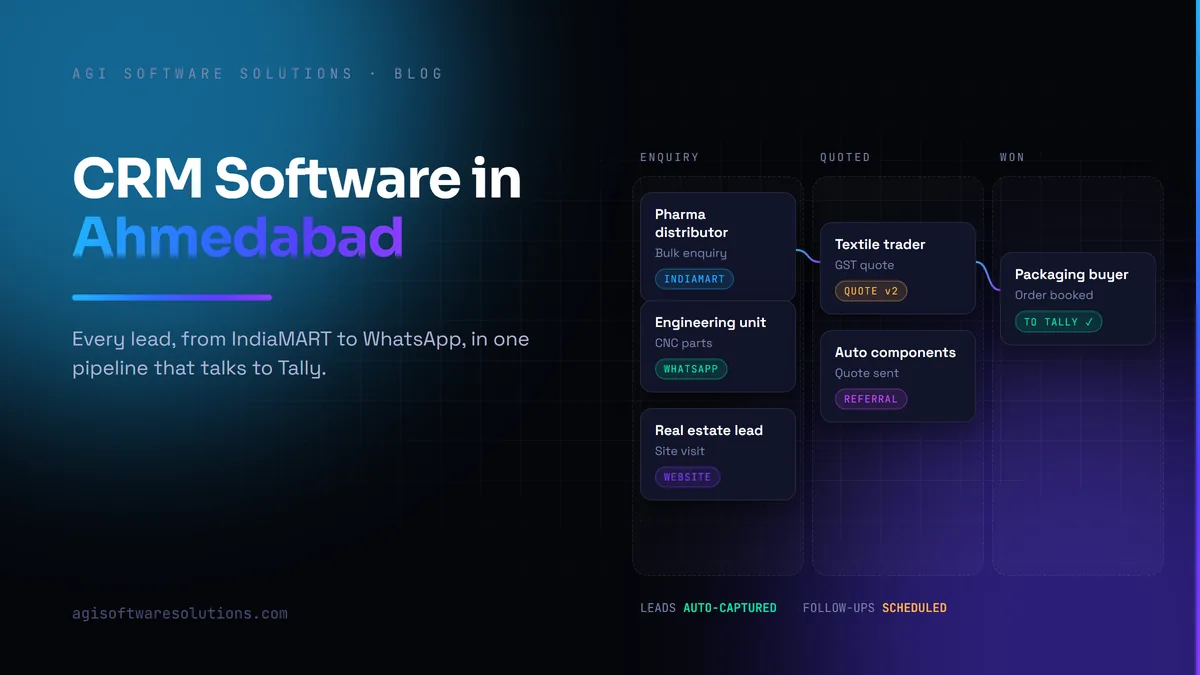
The right CRM software for an Ahmedabad business is the one that captures leads where they actually arrive (WhatsApp, IndiaMART, phone calls, dealers) and hands orders cleanly to Tally or your ERP. Feature lists matter far less than those two connections, and a CRM your sales team will not open on their phone has failed regardless of its price.
Most CRM buying guides are written for a US software company with an inside sales team and a marketing department. That is not how a typical Ahmedabad business sells. A pharma distributor in Naroda, a machinery manufacturer in Vatva, a real-estate developer on SG Highway and a textile trader near Kalupur all run sales very differently from each other, and none of them looks like the template. This guide covers what to look for in CRM software in Ahmedabad, what it costs, and how to roll it out without the system being quietly abandoned three months later.
What is CRM software?
CRM stands for Customer Relationship Management. CRM software is a shared system that records every lead, customer, conversation, quotation and follow-up in one place, so the whole sales team works from the same information instead of personal phones, diaries and Excel sheets. A typical CRM covers lead capture, a sales pipeline, quotations, task reminders, customer history and sales reports. It sits alongside your accounting software (usually Tally in Ahmedabad) rather than replacing it.
How Ahmedabad businesses actually sell
Before comparing products, write down where your enquiries come from and where orders end up. In the businesses we speak to across Ahmedabad, the pattern is remarkably consistent:
- Enquiries arrive in fragments. IndiaMART and TradeIndia leads, WhatsApp messages to a salesperson's personal number, calls to the office landline, website forms, trade-fair visiting cards and dealer referrals.
- Quotations are negotiated, not published. Pricing depends on quantity, customer, payment terms and freight, and the quote goes out as a PDF on WhatsApp or email with GST shown correctly.
- Follow-up is relationship-driven. Repeat buyers expect the same person, a phone call, and memory of what they ordered last time.
- The accounting system is the source of truth. Usually Tally, sometimes an ERP. Outstanding payments, credit limits and dispatch status live there, not in the CRM.
A CRM that ignores any of these becomes a second place to type the same information. That is the single most common reason CRM projects fail here: not bad software, but duplicate work nobody has time for.
The features that matter for CRM in Ahmedabad
Every CRM has contacts, deals and a pipeline. These are the capabilities that separate a useful system from an expensive address book for a local business.
1. Lead capture from every channel, automatically
IndiaMART offers a lead API, website forms can post directly, and the WhatsApp Business Platform lets messages land in a shared inbox rather than on one person's phone. If leads still have to be copied in by hand, response time will slip and leads will be lost. Ask any vendor to demonstrate an IndiaMART lead appearing in the CRM within a minute, assigned to the right person.
2. WhatsApp as a first-class channel
For most Ahmedabad businesses, WhatsApp is the sales channel. The CRM should log conversations against the customer record, send approved message templates (quotation follow-ups, payment reminders, dispatch updates) and keep the history when a salesperson leaves. Using the official WhatsApp Business Platform rather than unofficial tools also protects your number from being blocked. We cover the technical side in WhatsApp AI agents for business.
3. GST-ready quotations
Quotes should carry your GSTIN, HSN codes and the correct split of CGST and SGST for buyers within Gujarat or IGST for buyers outside it. A CRM that cannot do this pushes quoting back into Excel, and the CRM loses sight of the deal at exactly the moment it matters.
4. Two-way sync with Tally or your ERP
When a quote is accepted, the order should flow into Tally or your ERP without retyping. In the other direction, salespeople should see outstanding balances and credit status before promising another consignment. This integration is where most of the value sits, and also where most of the implementation effort goes. If you are outgrowing Tally altogether, read our companion guide to ERP software in Ahmedabad.
5. A mobile app your field team will actually use
Field sales staff visiting dealers in Sanand, Changodar or Mehsana need to log a visit, check stock and send a quote from their phone in under a minute. Test the mobile app on a mid-range Android handset on a patchy connection, not the vendor's demo laptop.
6. Language and simplicity
Customers write in English, Gujarati and Hindi, often mixed in the same message. The CRM should store and search all three. More importantly, screens should be simple enough that a salesperson who has never used a CRM can follow them without training.
Real estate CRM in Ahmedabad
Real-estate developers and brokers are among the heaviest CRM users in the city, because a single project can generate thousands of enquiries from property portals, Facebook and Instagram ads, hoardings and channel partners. A real estate CRM in Ahmedabad needs a few things a general CRM may not offer out of the box:
- Site-visit scheduling with reminders to the buyer and the sales executive.
- Broker and channel-partner attribution, so commissions are calculated on the right bookings.
- Inventory by tower, floor and unit, with holds and bookings visible to the whole team.
- Payment-schedule follow-up after booking, linked to construction milestones.
CRM for Naroda, GIDC and Ring Road businesses
East Ahmedabad sells differently again. Manufacturers and traders in Naroda GIDC and the neighbouring industrial estates along Sardar Patel Ring Road mostly sell through dealers and distributors, quote per order, and run dispatch and payments out of Tally. A CRM for these businesses needs:
- Dealer and distributor accounts with their own price lists, credit limits and outstanding balances pulled from Tally, so a salesperson never quotes a customer who is over limit.
- Enquiry-to-order tracking for B2B buyers: IndiaMART and TradeIndia leads, repeat orders on WhatsApp, and sample requests, each with a next follow-up date.
- Visit and route planning for field sales covering dealers across Gujarat, with visit notes logged from a phone.
- Dispatch and payment status visible inside the CRM, so customers asking "where is my order?" get an answer without a call to the accounts team.
Costs follow the same three routes described below. Our office is at K Star Business Hub on Sardar Patel Ring Road, Muthiya, next to Naroda, so for businesses in east Ahmedabad we can meet at your factory or at ours.
CRM software commonly shortlisted in Ahmedabad
Searches for the best or top CRM software in Ahmedabad mostly return the same handful of products, plus local CRM software providers that build or customise systems. This is not a ranking; each fits a different kind of business:
- Zoho CRM and Bigin by Zoho: widely used by Indian SMEs; Bigin is Zoho's simpler pipeline-only CRM for small teams.
- HubSpot CRM: offers a free starting tier and strong marketing tools; costs rise with paid hubs and contacts.
- Salesforce: very configurable and suited to larger or multinational sales organisations, with a matching price and implementation effort.
- LeadSquared: an Indian CRM frequently used in real estate, education and lending for high-volume lead handling.
- Freshsales (Freshworks): a sales CRM with built-in phone and email, popular with mid-sized teams.
- Custom CRM software: built by a CRM software development company in Ahmedabad when dealer pricing, schemes or production links do not fit any product.
Whichever you shortlist, test it against your own enquiries, quotations and Tally data rather than the vendor's demo data.
CRM software price in Ahmedabad: off-the-shelf, customised or custom-built?
There are three realistic routes, and the right one depends on how standard your sales process is.
| Route | Typical cost | Best for | Watch for |
|---|---|---|---|
| SaaS CRM (Zoho, HubSpot, Salesforce, LeadSquared) | ₹800–₹6,000 / user / month | Standard B2B pipelines, smaller teams | Per-user costs climb as you grow; Tally and IndiaMART links may need paid connectors |
| SaaS CRM plus custom integrations | Subscription + ₹1.5–6 lakh one-time | Most growing Ahmedabad SMEs | Integrations need an owner when either system updates |
| Custom CRM software | ₹8–30 lakh+ one-time | Dealer networks, unusual pricing, many users | Needs a clear specification and a partner who will maintain it |
These ranges are indicative of what we see in the Ahmedabad market in 2026, not a quotation; your number depends on users, integrations and data migration. Our view is that most businesses should start with a good SaaS CRM and invest in the integrations. Custom software earns its cost when your process is a competitive advantage that no product models well. We wrote the full argument in custom CRM vs off-the-shelf.
Questions to ask any CRM vendor or implementation partner in Ahmedabad
- Can you show an IndiaMART lead and a WhatsApp message arriving in the CRM, live, during the demo?
- How exactly does an accepted quote reach Tally or our ERP, and what happens if the sync fails?
- Who owns our data, and how do we export all of it if we leave?
- What does the total cost look like in year three, with our expected number of users?
- Who supports us after go-live, in our working hours, and how quickly do they respond?
- Can we speak to a local customer with a sales process similar to ours?
A 90-day rollout plan that sticks
Days 1–15: map and clean. Document your current sales stages in plain language. Gather customer lists from Tally, Excel sheets and salespeople's phones, and remove duplicates. Agree on what counts as a lead, a quote and a won order.
Days 16–45: configure and connect. Set up the pipeline, quotation template and user roles. Connect IndiaMART, the website and WhatsApp first, because automatic lead capture is what convinces the team the system is worth using. Then connect Tally or the ERP.
Days 46–75: pilot with one team. Run one sales team or product line on the CRM only. Fix the friction they report every week. Resist adding features at this stage.
Days 76–90: roll out and measure. Move the rest of the team across, retire the old spreadsheets, and track three numbers: time to first response on new leads, quote-to-order conversion and overdue follow-ups. If those improve, the CRM is working.
Where AI fits in a CRM today
AI is useful in a CRM when it removes typing rather than adding novelty. Practical examples: reading an incoming WhatsApp enquiry and filling in product, quantity and city automatically; drafting a follow-up in the customer's language; summarising a long account history before a call; and flagging deals that have gone quiet. The prerequisite is clean, connected data, which is why integration work comes first. See AI integration for the systems you already run for how we approach this.
Working with a local partner
AGI Software Solutions is a software development company in Ahmedabad. We help businesses connect CRMs to Tally, ERPs, IndiaMART and WhatsApp, and build custom CRM software when an off-the-shelf product does not fit. Being in the same city means we can sit with your sales team for a day, which is often where the most useful requirements come from. If you are comparing options across the state, our guide to CRM software in Gujarat by industry may also help.
Not sure which CRM route fits your business?
Tell us how your enquiries arrive and where your orders end up. We will suggest a CRM setup and an integration plan for your Ahmedabad business, with no obligation to build anything with us.
Common questions
What is the best CRM software in Ahmedabad for a small business?
There is no single best product. For most small businesses in Ahmedabad, a mainstream SaaS CRM such as Zoho, HubSpot or LeadSquared is the right start, provided it can capture IndiaMART, website and WhatsApp leads automatically and pass orders to Tally. Choose on those integrations and on how easily your team can use the mobile app, not on the length of the feature list.
How much does CRM software cost in Ahmedabad?
SaaS CRMs typically cost ₹800–₹6,000 per user per month. Connecting one to Tally, IndiaMART and WhatsApp usually adds a one-time ₹1.5–6 lakh. Custom CRM software generally starts around ₹8 lakh and can exceed ₹30 lakh for dealer networks with complex pricing. These are indicative 2026 market ranges, not a quote.
Can a CRM integrate with Tally?
Yes. Tally supports data exchange through its XML and ODBC interfaces and through TallyPrime connectors, so accepted quotations can create sales orders or invoices in Tally, and outstanding balances can be shown in the CRM. The integration should handle failures visibly, so a missed sync is noticed rather than silently lost.
Should we build a custom CRM or buy one?
Buy first in most cases. Custom CRM software is worth it when your sales process is unusual and is a real competitive advantage, for example multi-tier dealer pricing, complex schemes or deep links to production planning, or when per-user SaaS fees at your team size exceed the cost of building and maintaining your own.
What is the full form of CRM?
CRM stands for Customer Relationship Management. CRM software keeps every lead, customer, conversation, quotation and follow-up in one shared system, so a sales team can respond faster, follow up consistently and keep customer history when staff change.
Can ChatGPT make a CRM?
ChatGPT and similar AI tools can help draft a simple CRM, write code or suggest a pipeline design, but they do not replace a maintained system with secure hosting, user permissions, backups and Tally or WhatsApp integrations. A more practical use is adding AI inside an existing CRM, for example to read WhatsApp enquiries, draft follow-ups or summarise customer history.