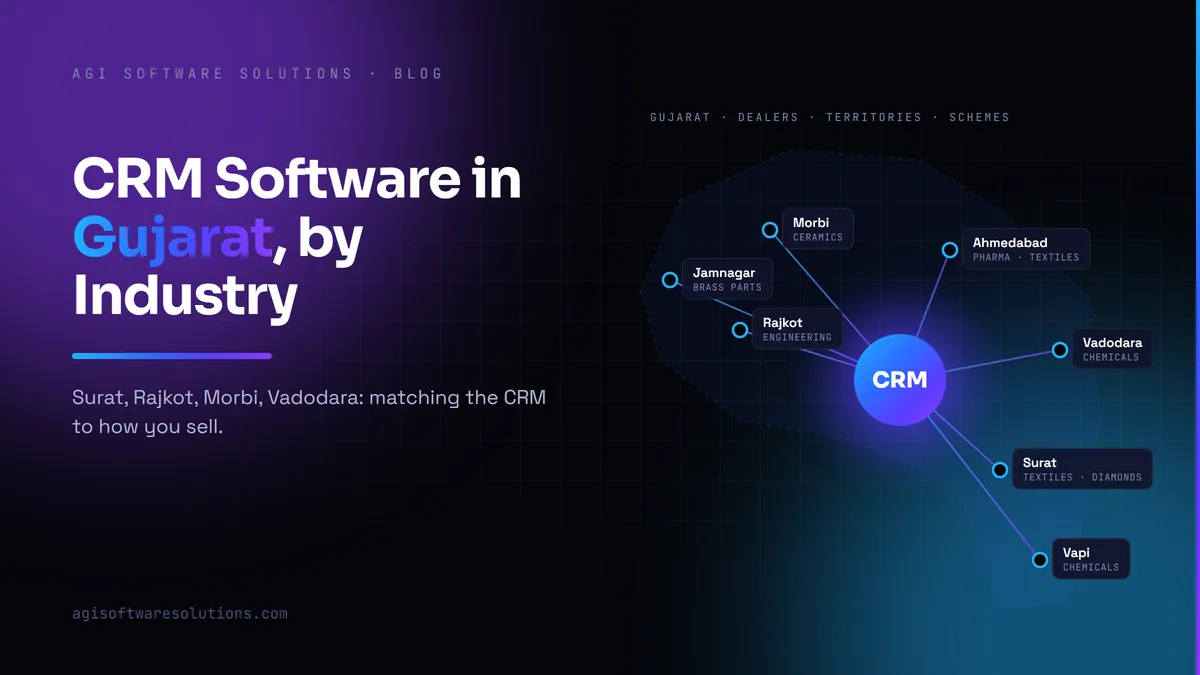
Gujarat’s industries sell in very different ways, so the right CRM software depends less on the brand and more on your sales model. Dealer-and-distributor businesses need scheme and territory management, project sellers need long-cycle opportunity tracking, and exporters need multi-currency quotes and follow-up across time zones. Start by naming your model, then choose the CRM.
Gujarat is not one market. Within a few hours' drive you will find diamond and textile traders in Surat, auto-component and engineering firms in Rajkot, the ceramic tile cluster in Morbi, brass-part makers in Jamnagar, chemical and engineering companies around Vadodara, Ankleshwar and Vapi, and pharma, textile and real-estate businesses in Ahmedabad. A CRM that suits one of these can be a poor fit for the next. This guide maps common sales models in Gujarat to what your CRM software must do. For buying and rollout advice specific to Ahmedabad, see our CRM software in Ahmedabad buyer's guide.
CRM meaning in Gujarati
CRM stands for Customer Relationship Management, commonly rendered in Gujarati as “ગ્રાહક સંબંધ વ્યવસ્થાપન” (grahak sambandh vyavasthapan). In practice it means one shared system where a business records every enquiry, customer, quotation, order and follow-up, instead of keeping them in salespeople's phones and notebooks. For a Gujarat business, a CRM typically connects to WhatsApp for conversations and to Tally or an ERP for invoices and outstanding payments.
Four sales models, four different CRMs
| Sales model | Common in | The CRM must handle |
|---|---|---|
| Dealer and distributor network | Ceramics, pumps and motors, building materials, FMCG | Territories, dealer targets, schemes, secondary sales, field visits |
| Direct B2B, repeat orders | Textiles, chemicals, packaging, components | Price lists per customer, reorder reminders, credit limits, Tally/ERP sync |
| Project and tender selling | Engineering, machinery, solar, infrastructure | Long opportunities, multiple stakeholders, revisions, tender documents |
| Export | Ceramics, engineering, chemicals, agro products | Multi-currency quotes, Incoterms, sample tracking, time-zone follow-up |
Industry by industry
Surat: textiles and diamonds
Surat's textile trade runs on agents, brokers and long credit cycles, with very high order volumes and thin margins. A CRM here is mainly a collections and repeat-order tool: who ordered which quality last season, what is outstanding, which agent introduced the buyer and what commission is due. Speed matters more than depth, and WhatsApp catalogues are often the main sales channel, so the CRM must log WhatsApp conversations and send templates from a shared business number.
Rajkot and Jamnagar: engineering, auto parts and brass components
These are largely direct B2B sellers with repeat customers, frequent drawing revisions and quotes that depend on material prices. The CRM needs versioned quotations, links to drawings and specifications, and a view of order status from production. Many Rajkot firms also export, so multi-currency quoting matters.
Morbi: ceramics and tiles
Morbi's ceramic cluster sells through large dealer networks across India and through exporters. The CRM requirements here are classic dealer management: territory assignment, dealer-wise targets and achievement, scheme calculation, display and sample tracking, and field-visit logging with location. Secondary-sales visibility (what the dealer actually sold on) is the hard part and usually needs a simple dealer portal or app.
Vadodara, Ankleshwar and Vapi: chemicals and engineering
Chemical sales involve technical qualification, sampling and documentation such as specifications and safety data sheets before a first order, then steady repeat business. The CRM should track samples and trials as pipeline stages, store documents against each product and customer, and remind the team of reorder windows based on consumption history.
Ahmedabad: pharma, textiles, real estate and services
Ahmedabad mixes several models. Pharma distribution needs medical-representative visit tracking and stockist management. Real-estate developers need site-visit scheduling, broker attribution and booking follow-up. Service businesses need a straightforward lead-to-proposal pipeline. Our Ahmedabad guide covers these in more detail.
What every CRM in Gujarat should have
- WhatsApp integration through the official Business Platform, with conversation history kept against the customer, not on a salesperson's phone.
- GST-correct quotations, splitting CGST and SGST for intra-state buyers and IGST for buyers outside Gujarat.
- Accounting sync with Tally or your ERP, so salespeople see outstanding payments before booking new orders.
- Multi-location teams: branch and territory permissions so a Surat manager sees Surat, and head office sees everything.
- Gujarati, Hindi and English in names, addresses and notes, with search that works across all three.
- A reliable mobile app that works on patchy connections for field staff travelling between towns.
Dealer management: where off-the-shelf CRMs struggle
Mainstream CRM software is built around a company selling directly to a buyer. Gujarat's dealer-led industries add a layer in between: you sell to a dealer, the dealer sells to a contractor or retailer, and your schemes and targets depend on both. Generic CRMs can be stretched to model this, but schemes, slab discounts and secondary sales tend to end up back in Excel.
This is the most common case where we recommend a hybrid: a standard CRM for the sales team, plus a small custom dealer portal and scheme engine connected to it and to the ERP. It keeps licence costs down and puts custom development only where your process is distinctive. Our custom web application and systems integration services cover exactly this kind of build.
What CRM software costs in Gujarat
CRM software prices in Gujarat follow the same three routes as anywhere in India: a SaaS subscription charged per user per month, a subscription plus one-time integration work, or a custom-built system. Typical 2026 ranges for each route, in rupees, are in the cost table of our Ahmedabad CRM guide. Two factors push Gujarat projects towards the upper end: dealer portals for secondary sales, and integrations across several branches or GSTINs.
Choosing a CRM partner in Gujarat
Whichever product you choose, the partner matters as much as the software. Look for one who will:
- Spend time with your sales team and dealers before configuring anything.
- Show a working integration with Tally or your ERP, not just a slide about it.
- Agree in writing that you own your data and can export it at any time.
- Offer support in your working hours and visit when something needs fixing in person.
- Explain the three-year total cost, including per-user fees as your team grows.
For the broader build-or-buy question, read custom CRM vs off-the-shelf. If your CRM decision is tied to replacing Tally or spreadsheets for operations as well, read about ERP software for Ahmedabad and Gujarat businesses first, because the two systems should be planned together.
Planning a CRM for a multi-city team or dealer network?
We are based in Ahmedabad and work with businesses across Gujarat. Share your sales model and current tools, and we will outline a CRM and integration plan that fits it.
Common questions
Which CRM software is best for businesses in Gujarat?
It depends on your sales model. Direct B2B sellers with repeat orders are usually well served by mainstream SaaS CRMs such as Zoho or HubSpot connected to Tally. Dealer-led industries such as ceramics and building materials often need extra dealer, scheme and secondary-sales features, which may mean a CRM plus a small custom dealer portal.
Can a CRM manage dealers and distributors?
Some CRMs offer partner or channel modules, but most handle dealer targets, slab schemes and secondary sales only partly. Businesses with large dealer networks in Gujarat often combine a standard CRM with a custom dealer app or portal that feeds orders and sales data back into the CRM and ERP.
Does CRM software support Gujarati?
Most modern CRMs store and display Gujarati text correctly because they use Unicode, so names, addresses and notes in Gujarati work. Fewer offer a fully Gujarati interface. Test search with mixed Gujarati, Hindi and English entries before you commit, since that is where problems usually appear.
How should GST be handled in CRM quotations?
Quotations should show your GSTIN and HSN or SAC codes and apply CGST plus SGST for buyers within Gujarat and IGST for buyers in other states, based on the place of supply. The CRM should pass the accepted quote to Tally or your ERP so the invoice matches what the customer agreed.
What are the most widely used CRMs in India?
Commonly shortlisted CRMs in India include Zoho CRM, HubSpot CRM, Salesforce, Freshsales by Freshworks and LeadSquared. Each suits a different type of business, so compare them on WhatsApp support, Tally or ERP integration, mobile use and three-year cost for your team size rather than on general rankings.
Is there an IT hub in Gujarat?
Yes. Ahmedabad and neighbouring Gandhinagar are the state’s main technology centres, with Gandhinagar home to GIFT City and the Infocity IT park. Vadodara, Surat and Rajkot also have established software firms, so businesses across Gujarat can usually find CRM implementation partners within the state.