Every company runs a few processes that no product on the market quite fits. The gap gets patched with spreadsheets, a shared inbox and one person who remembers how it all works. A custom web application is what replaces that patch — and it should pay for itself in the hours it hands back.
AGI Software Solutions is a custom web application development company building internal tools, customer portals and operational platforms on React, Next.js, FastAPI and PostgreSQL — with AI wired in only where it removes real work. Custom web app builds typically run $25k–$45k for a focused internal tool and $50k–$150k for a multi-role operational platform, and the repository, infrastructure and data are yours from the first commit.
Off-the-shelf products are built for the average of a thousand companies. When your process is the thing that makes you competitive, that average is exactly what you cannot afford to adopt.
The screens match the steps your team already takes, so nobody maintains a private spreadsheet to cover what the software will not do.
Repository, infrastructure and data in your accounts. No per-seat meter, and no vendor holding your operations at the renewal negotiation.
ERP, CRM, accounting, warehouse and payment systems read and written directly, instead of people retyping between tabs.
Document reading, drafting, classification and search added where they remove genuine work — and left out where a well-designed form is faster.
A custom web application is business software delivered through the browser and built for one organisation rather than sold to many. It runs in your cloud account, models the workflow you actually have rather than a generic approximation of it, and reads and writes directly against the systems that already hold your data.
The practical test is simple. If your team keeps a spreadsheet alongside a product you already pay for, the product does not fit the process. That gap — not the licence fee — is what a custom application removes.
Both are legitimate answers, and we will recommend the product when the product is right.
| Off-the-shelf SaaS | Custom web application | |
|---|---|---|
| Process fit | You adapt to the product | The software is built around your process |
| Time to first value | Days | 6–16 weeks |
| Cost shape | Per seat, forever, rising with headcount | One build, then hosting and maintenance |
| Integrations | Whatever the vendor chose to support | Anything with an API or a database |
| Leaving | Export what the vendor allows | Nothing to leave — you already own it |
| Right choice when | The process is standard and undifferentiated | The process is how you compete |
The same process on every engineering project, scaled to the size of the problem.
We map what the process actually does today, including the parts that live in one person’s head, and what it costs when it goes wrong.
Data model, integration points, permissions and hosting decided up front, because these are the choices that are expensive to reverse later.
Working software every couple of weeks, sequenced so the riskiest piece reaches real users first rather than last.
Connecting to the systems that hold your data, then security, load and failure testing against realistic volumes instead of demo data.
Documentation, a walkthrough for whoever maintains it, and ongoing support if you want it. The repository is yours either way.
The patterns we see deliver, across startups, SMEs and enterprise teams.
The operations tracker, approval queue or scheduling board your business actually runs on, rebuilt with permissions, history and an audit trail.
Self-service for orders, documents, tickets and account data, so the questions that fill your inbox get answered without anyone answering them.
Multi-role systems where dispatch, field teams, finance and management each see the same data through a view built for their job.
Software you sell rather than only use, with tenant isolation, billing and onboarding designed in from the first sprint.
Deliberately boring, widely supported technology. The goal is software your team can still hire for in five years.
React, Next.js and TypeScript, with server rendering where it earns its keep for speed or SEO.
FastAPI, Django and Node.js. Python where the work touches data or models, TypeScript where it does not.
PostgreSQL as the default, Redis for caching and queues, and a vector store only when retrieval genuinely needs one.
Docker and Kubernetes on AWS, GCP, Azure or your own servers. Your cloud account, your bill, your control.
REST and GraphQL APIs, webhooks, message queues and MCP servers for the systems that need to talk to AI.
Automated tests, CI on every commit, staged deploys and monitoring wired in before launch rather than after the first outage.
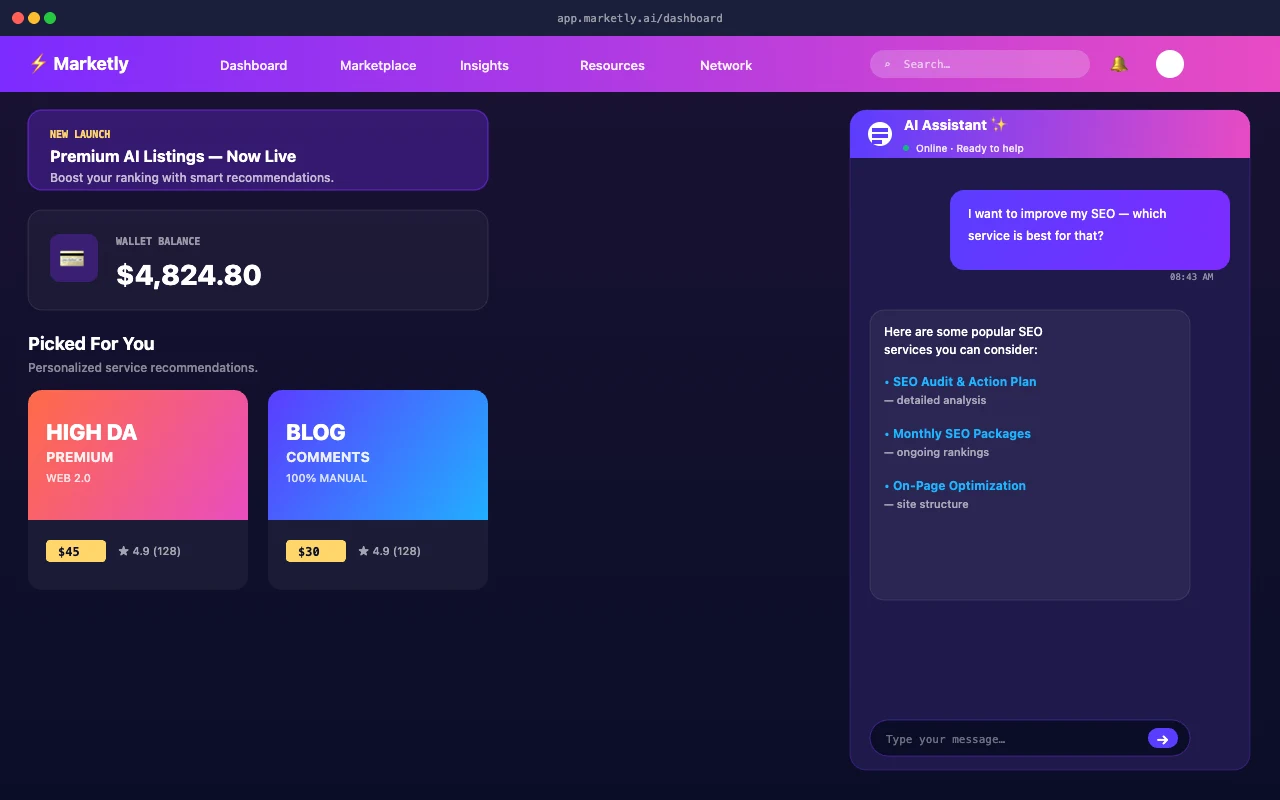
Support chatbot, live SEO analyser and a vector recommendation engine, all sharing one retrieval layer.
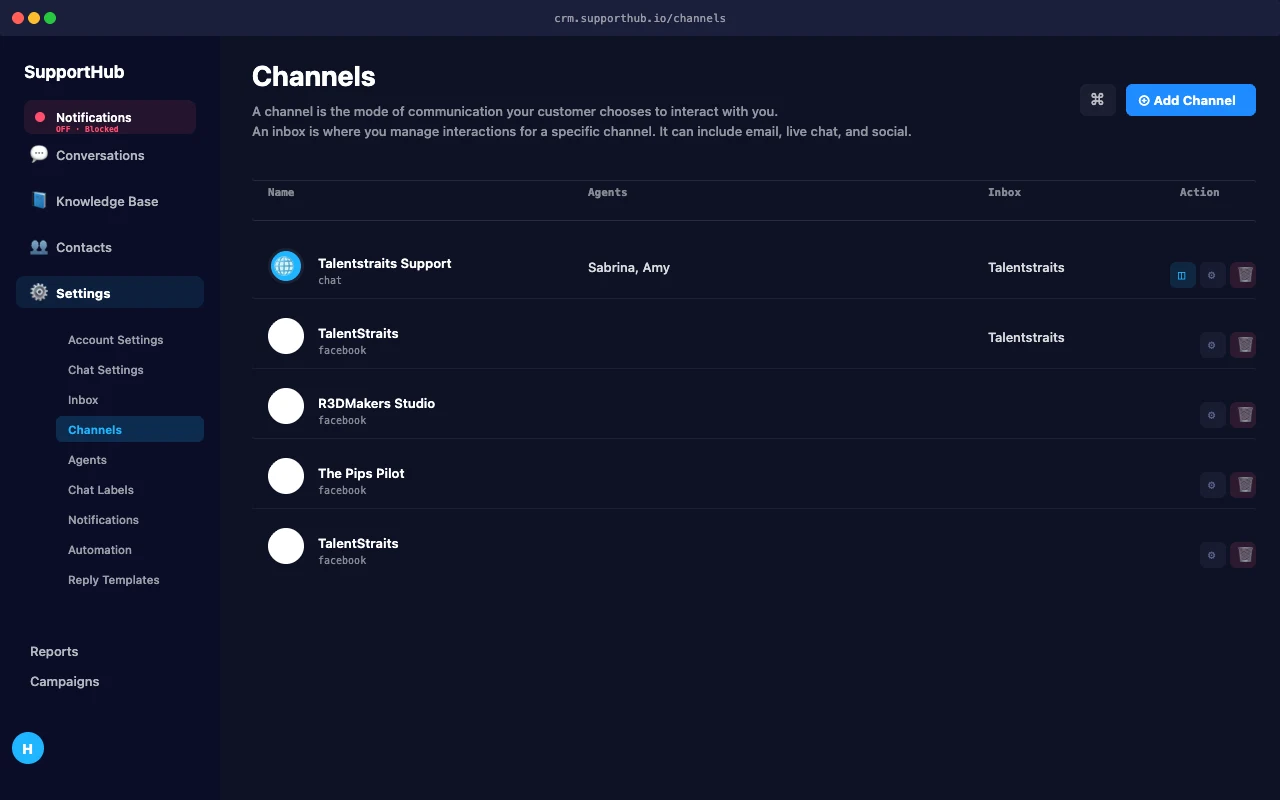
One inbox across web chat, email, WhatsApp and Facebook, with AI replies trained on past resolutions.
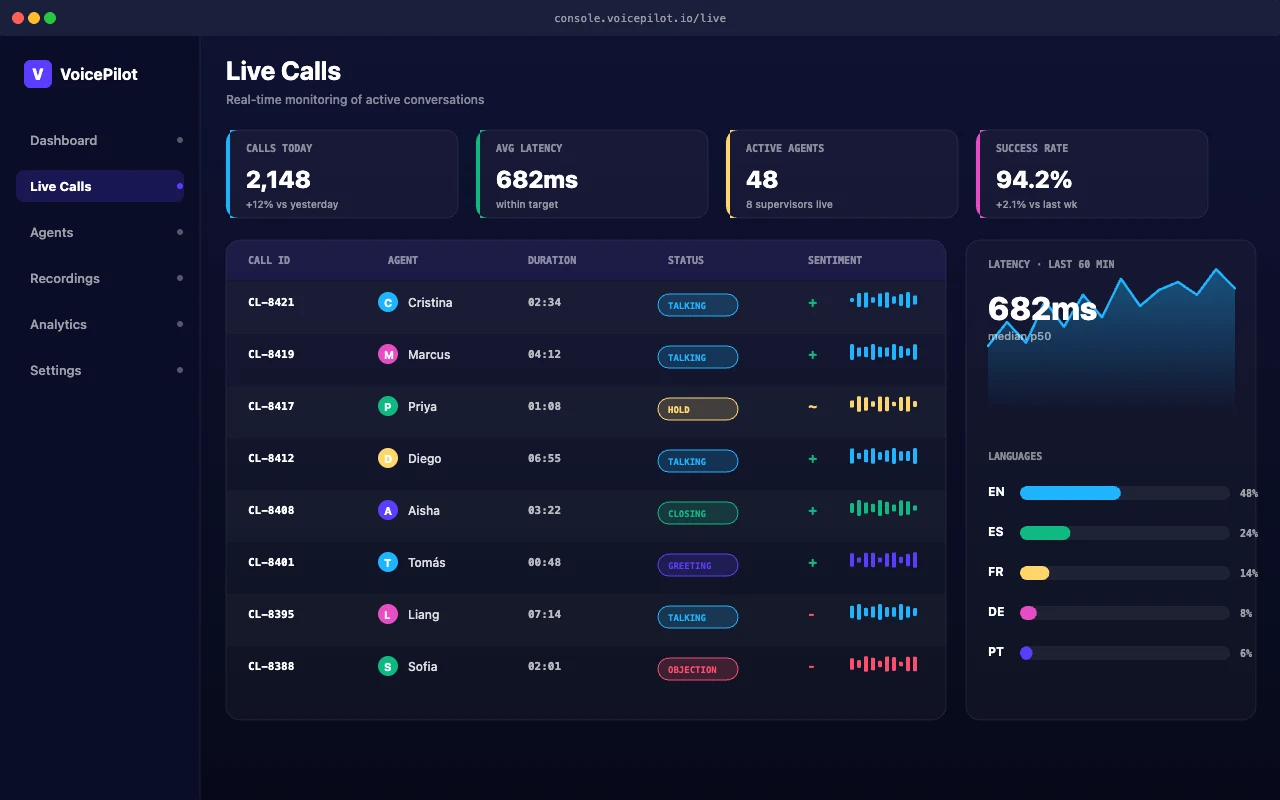
A streaming voice pipeline with real barge-in, running thousands of live calls a day in 12 languages.
“We needed a voice agent that could actually qualify leads, not a chatbot pretending to be one. The team shipped a sub-700ms pipeline in 6 weeks. It now handles 5k calls a day.”
“What sold us was their willingness to put AI engineers and product designers on the same call. We got working prototypes by week two and a production rollout in three months.”
“AGI designed a CRM system tailored to our client management process. It is intuitive, reliable, and has centralized all our communication and history in one dashboard. This has greatly improved client retention.”
A focused internal tool with a few roles and one integration typically runs $25k–$45k. A customer portal or operational platform with several roles, live integrations and reporting runs $50k–$100k. Multi-tenant products with billing and onboarding start around $120k. The two things that move the number most are the count of integrations and the compliance requirements — rarely the interface.
A focused tool reaches production in 6–10 weeks. A multi-role platform runs 4–7 months. We ship usable software every couple of weeks throughout, so you are never waiting until the end to find out whether it fits.
React and Next.js on the front end, FastAPI, Django or Node.js on the back end, PostgreSQL for data, deployed in Docker on AWS, GCP, Azure or your own servers. We pick boring, well-supported technology deliberately: the goal is software your team can still hire for in five years.
Often, yes, and we will tell you so. If the process is standard — payroll, accounting, email marketing — buy the product. Custom earns its place when the process is what makes you competitive, or when the per-seat cost of a product you have outgrown now exceeds the cost of owning the alternative.
Yes. Repository, infrastructure and data live in your accounts, and handover includes documentation plus a walkthrough for whoever maintains it. We are glad to keep maintaining it — you should never be stuck with us because leaving is hard.
Usually only in parts. We add document reading, search, drafting or classification where they remove real work, and leave them out where a well-designed form is faster and cheaper. An AI feature that impresses in a demo and slows the daily user down is a net loss.
Tell us what the system would need to do and what it is replacing. We will tell you whether it is worth building and roughly what it takes.