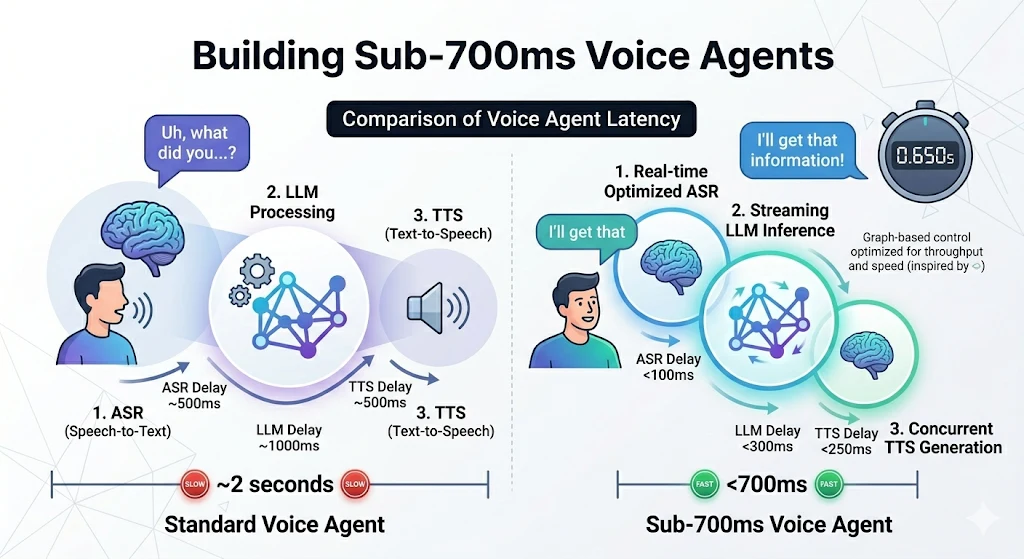
An AI receptionist answers every call instantly, books appointments and routes urgent calls, for roughly $100–$500 a month. A human answering service costs $1–$3 per call and handles nuance better. The 2026 change is latency: average end-to-end response has fallen to about 280ms, below the 300ms threshold where a conversation stops feeling like a phone tree.
Most small businesses are not choosing between an AI receptionist and a human receptionist. They are choosing between an AI receptionist and voicemail, because the calls are already going unanswered. That framing changes the maths considerably.
The four options
| Option | Cost | Handles | Fails at |
|---|---|---|---|
| IVR phone tree | $20–$100 / mo | Routing to a department | Anything a caller cannot map to a menu number |
| Human answering service | $1–$3 / call | Messages, basic screening, genuine nuance | Booking in your systems; cost scales with volume |
| AI receptionist | $100–$500 / mo | FAQs, bookings, routing, after-hours, unlimited concurrency | Unusual situations; needs a good escalation path |
| Custom voice agent | $20k–$120k build | Your workflows, your systems, your compliance rules | Overkill below a few hundred calls a month |
A vocabulary note, because the categories blur in the marketing. "AI answering service" and "AI receptionist" are used for the same product by different vendors, and both usually mean row three. The distinction that matters is not the name, it is whether the thing can book into your calendar and look up your data, or whether it only takes a message. Ask that question and the four rows collapse into two.
What changed in 2026
Voice AI crossed a quality threshold this year, and it is worth being precise about which one. Average end-to-end latency, from the caller finishing a sentence to the agent starting its reply, dropped to roughly 280ms. Below about 300ms, people stop noticing they are waiting and start talking normally. Above it, they interrupt, repeat themselves, or hang up. That single number is most of the difference between a 2024 voice bot people complained about and a 2026 one they do not comment on.
Market context: the voice AI agent segment is reported at around $4.8B in Q1 2026, up from roughly $3.3B in 2025, with autonomous phone handling the fastest-growing sub-segment at about 38% year on year, and SMB managed services growing fastest of all (CX Today, Brilo AI). Vendor-sourced figures, but they match what we see: the buyers are increasingly non-technical owners purchasing their first AI system of any kind.
The engineering behind that latency number is not trivial, and we wrote up how it is achieved in sub-700ms voice agents, including why the naive pipeline lands around two seconds.
What an AI receptionist actually handles
Realistic expectations, based on systems we run:
- Hours, location, services, pricing. Near perfect. This is most of the call volume for many small businesses.
- Appointment booking, rescheduling and cancellation. Reliable when wired directly into your calendar or practice management system.
- Qualifying and routing. Reliable. Capture the details, decide urgency, transfer or take a message.
- Payments and account changes. Possible, but this is where you want confirmation steps and an audit trail.
- Upset customers and genuine edge cases. Escalate. Trying to handle these is how you damage a relationship you could have kept.
A well-configured system handles 60–80% of inbound calls end to end for a typical small business. Anyone quoting 95% is either counting differently or has not run it against real callers.
On "50% lower cost per call"
You will see this figure everywhere. What it usually includes: the per-call cost of the AI versus the loaded hourly cost of the person who used to answer. What it usually excludes: setup and integration, the time spent configuring and correcting it in the first two months, the escalation path, and the fact that a receptionist does things other than answer the phone.
The honest version of the benefit is usually not cost reduction at all. It is captured revenue. A clinic or trade business that was missing 30% of its calls, and booking most of what it did answer, is losing bookings at a rate that dwarfs the cost of either option. Measure calls answered and appointments booked, not cost per call, and the decision usually becomes obvious.
When to buy a product and when to build
Buy an off-the-shelf AI receptionist if your needs are answering, FAQs, booking into a common calendar system and routing. The products in this category are good now and cost a fraction of a build.
Build a custom voice agent when the call has to touch your own systems (a proprietary booking system, an ERP, a regulated workflow), when you need outbound as well as inbound, when compliance rules govern what can be said, or when volume is high enough that per-minute pricing exceeds a build. That crossover typically sits in the low thousands of calls per month.
Getting it right
- Design the escalation first. What happens on the calls it cannot handle determines how customers feel about the ones it can.
- Say it is an AI. Callers work it out anyway, and being told up front reads as confidence rather than deception.
- Listen to the first hundred calls. Every one. It is the single highest-value thing you will do, and the failures are never the ones you predicted.
- Watch abandonment, not just containment. A system that "handles" a call the caller gave up on is not handling anything.
Our voice AI ROI piece has the fuller measurement framework, and if you want to talk through whether your call volume justifies a build, get in touch.
Common questions
How much does an AI receptionist cost?
Off-the-shelf AI receptionists cost roughly $100–$500 a month for a small business, usually priced by call minutes. A human answering service costs $1–$3 per call, so AI becomes cheaper at moderate volume. A custom voice agent built around your own systems costs $20,000–$120,000 to build plus running costs.
What is the difference between an AI receptionist and an answering service?
An answering service uses people to take messages and do basic screening, charged per call. An AI receptionist answers instantly with unlimited concurrency, books appointments directly into your calendar, and costs a flat monthly fee. People handle genuine nuance better; AI handles volume, after-hours coverage and booking better.
What percentage of calls can an AI receptionist handle?
A well-configured AI receptionist handles 60–80% of inbound calls end to end for a typical small business, covering hours, services, pricing, bookings and routing. The remainder should escalate to a human. Treat quoted rates above 90% with caution, and always measure caller abandonment alongside containment.
Do callers know they are talking to an AI?
Usually yes, and you should tell them. Latency has dropped to around 280ms, which makes conversation feel natural, but most callers still identify it as automated. Disclosing it up front reads as confidence, avoids the moment of realisation mid-call, and is increasingly required by regulation in several markets.